

1. Is the file complete?
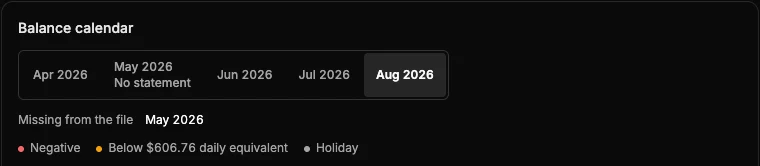
You need a statement for every account the business runs sales through, for every month your policy asks for, with every page. A missing month hides whatever happened in it, and a missing page hides its transactions, so check the file before you read a single figure.
- One statement per account per month, with no month skipped.
- Every page there: a statement that prints "page 3 of 6" should have six.
- Each statement opens on the balance the one before it closed.
- Transfers in from accounts you don't have. They point to an account the merchant didn't send.
2. Do the statements add up, and are they real?
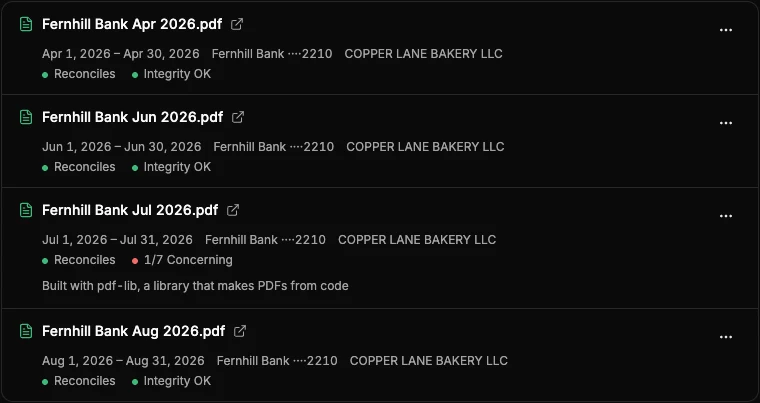
Opening balance plus credits minus debits should equal the closing balance the bank printed. A statement that doesn't reconcile has a line misread, missing or changed. Then look at the file itself: a PDF made by a PDF library, or saved again after it was first written, needs a closer look.
- Each statement reconciles from its opening balance to its closing balance.
- No transactions dated outside the statement period.
- The PDF's producing software, its creation and modification dates, and any saves after the first.
- If a file looks edited, ask for statements downloaded straight from the bank.
3. What is the true revenue?
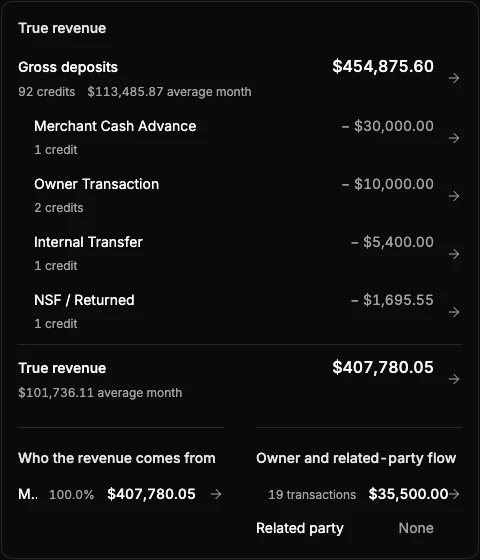
Gross deposits overstate sales. Take out transfers from the merchant's own accounts, owner and related-party money, loan and advance proceeds, reversals, returned items and bank interest. What's left is true revenue, the figure an advance should be sized on, month by month and on average.
- Transfers between the merchant's own accounts.
- Deposits from the owner, family or related businesses.
- Funding from MCAs and loans, which also dates each position.
- Reversed credits and returned items.
4. Which deposits need a source?
One large deposit can carry a month on its own. Ask what it was: a sale, a loan, the owner's money or a transfer. Underly marks a deposit worth 20% or more of an average month's true revenue as unverified and leaves it in true revenue, so you decide whether it belongs.
- Any deposit large enough to change the month by itself.
- Round-dollar wires and transfers with no clear payer.
- The share of true revenue from the largest payers. Revenue from one customer can stop with one customer.
5. Who is already pulling from the account?
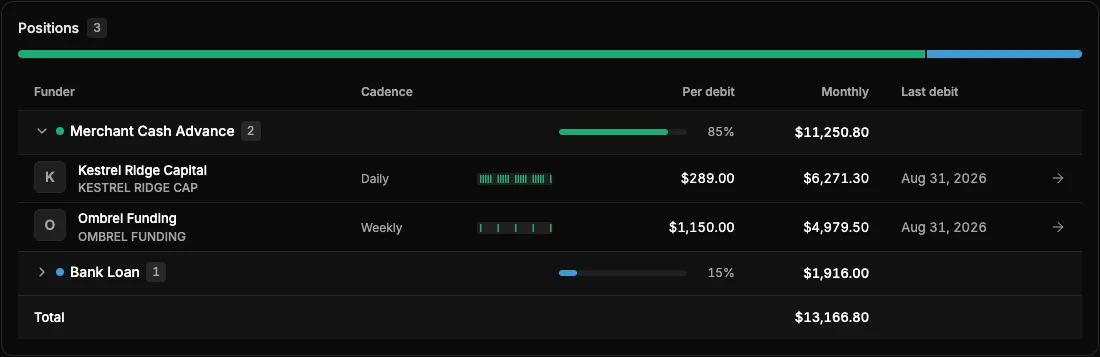
Every existing advance and loan collects from the same account. Find each series of fixed debits on a daily or weekly rhythm, name the funder behind each descriptor, and check whether it was still pulling at the end of the statements. Two or more open MCA positions mean the file is stacked.
- Each position's funder, payment, cadence and last debit.
- The funding deposit that opened it, if it's in the statements.
- Pulls that came back as an NSF or reversal, which weren't paid.
- Bank loans, leases and BNPL kept apart from MCAs, and card payments left out.
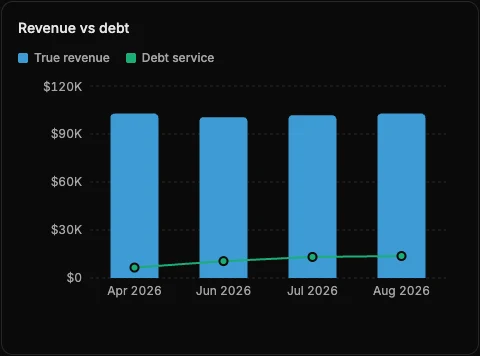
6. How much of revenue already goes to debt?
Turn every position into a monthly payment, add them up and divide by average monthly true revenue. That's debt-to-revenue. Set it against the holdback cap in your credit policy: what's left under the cap is the most a new advance can collect each month.
- Daily payments times 21.7 and weekly payments times 4.33 to get a month.
- True revenue underneath, not gross deposits.
- What actually cleared each month beside the run rate, so missed pulls show.
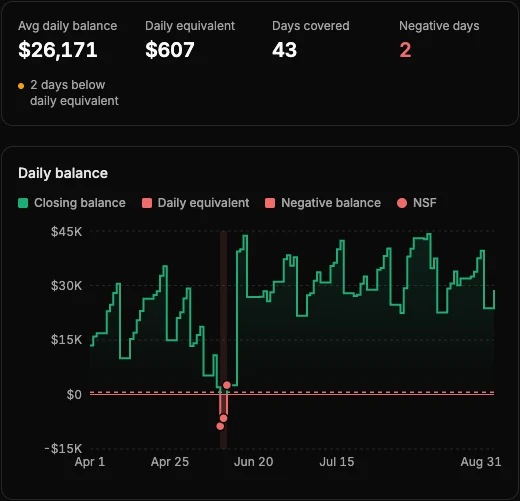
7. Can the balance carry a daily pull?
Revenue says whether the payments are affordable over a month; the balance says whether they clear on the day. Rebuild the closing balance for every day the statements cover, then count the negative days, the NSF returns and the days the account closed below what current funders pull on an average day.
- Average daily balance, and the lowest balance with its date.
- Negative days: closes below zero, not dips that recover by the end of the day.
- NSF returns and returned payments.
- Days that closed below the existing daily debt, the monthly debt divided by 21.7.
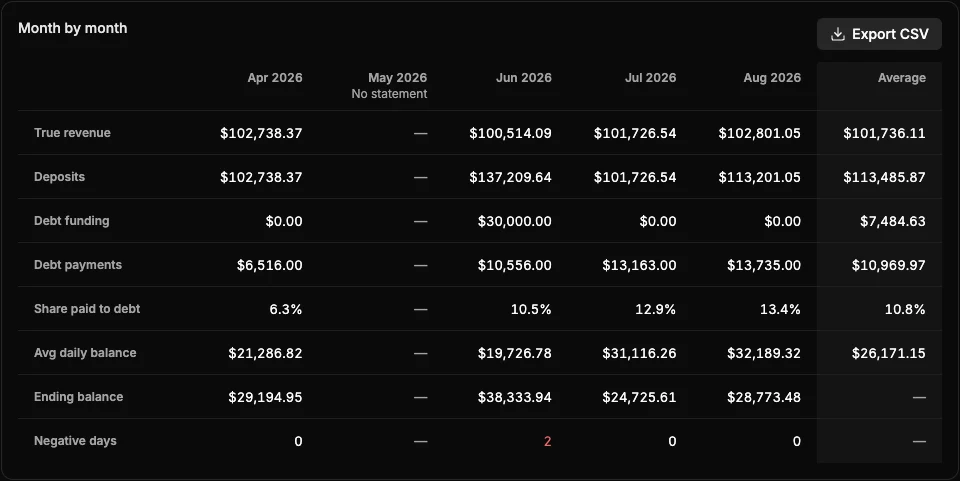
8. Is revenue holding up month to month?
An average can hide a business that's slowing down. Put the months side by side: true revenue, deposits, debt payments, the share paid to debt and the balances. A latest month well below the average, or debt payments climbing while revenue stays flat, is worth a question before you price.
- The latest month against the average.
- Months with no statement shown as gaps, not zeros.
- Debt payments rising faster than revenue, a sign of recent advances.
9. Price the offer
Size the payment to the room left under your holdback cap, then check what the offer costs. The advance times the factor rate gives the payback, the number of payments sets the daily or weekly amount and the term, and the estimated APR shows the cost over time.
MCA calculatorPayment, term, cost per dollar and estimated APR, with the share of revenue taken with existing positions.Outside the statements
The statements tell you how much the business can carry. The rest of the file tells you who you're funding:
- The application, the owner's ID and the business's registration with its state.
- A credit report on the owner.
- UCC filings and court records for liens, judgments and other funders.
- Your policy's rules on industry and time in business.
Your credit policy sets every threshold, from the holdback cap to the negative days you'll accept. This checklist tells you what to measure, not where to draw the line.